AWS AppFlow
AWS AppFlow is a fully managed data integration service that allows you to easily transfer data between SaaS applications, databases, Amazon S3, Amazon Redshift, Amazon Salesforce, Zendesk, Slack, and more.
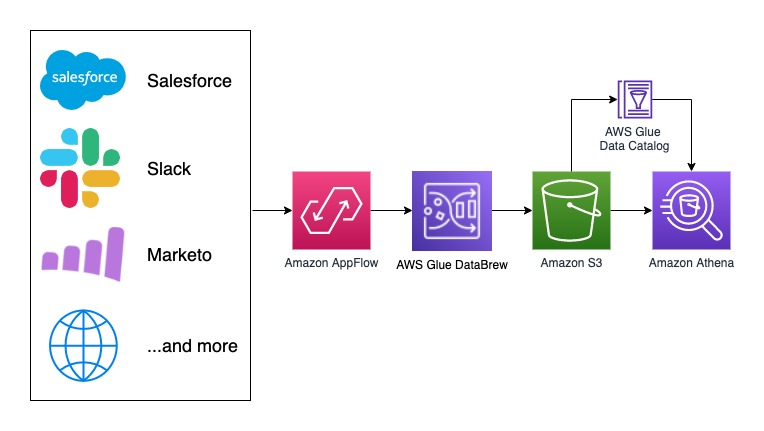
1. Key Features
- AppFlow automates the data transfer process without the need for complex custom code or manual intervention.
- It supports scheduled transfers as well as event-driven data transfers, allowing to move data in near real-time from source applications to destination targets.
- AppFlow provides pre-built connectors that make it easy to set up workflows between different applications, reducing operational complexity.
2. Common Use Cases
Suitable for data ingestion, analytics, real-time notifications, and automated workflows for business applications that need reliable, secure, and scalable data integration.
3. Question: Transfer data between SaaS and S3 bucket
A company's application integrates with multiple software-as-a-service (SaaS) sources for data collection. The company runs Amazon EC2 instances to receive the data and to upload the data to an Amazon S3 bucket for analysis. The same EC2 instance that receives and uploads the data also sends a notification to the user when an upload is complete. The company has noticed slow application performance and wants to improve the performance as much as possible. Which solution will meet these requirements with the LEAST operational overhead?
- Create an Amazon AppFlow flow to transfer data between each SaaS source and the S3 bucket. Configure an S3 event notification to send events to an Amazon Simple Notification Service (Amazon SNS) topic when the upload to the S3 bucket is complete. (
Correct Ans) - Create an Amazon EventBridge (Amazon CloudWatch Events) rule for each SaaS source to send output data. Configure the S3 bucket as the rule's target. Create a second EventBridge (Cloud Watch Events) rule to send events when the upload to the S3 bucket is complete. Configure an Amazon Simple Notification Service (Amazon SNS) topic as the second rule's target.
Explanation: While Option 2 approach can technically fulfill the requirement but it introduces more operational complexity compared to Solution 1