AWS Global Accelerator
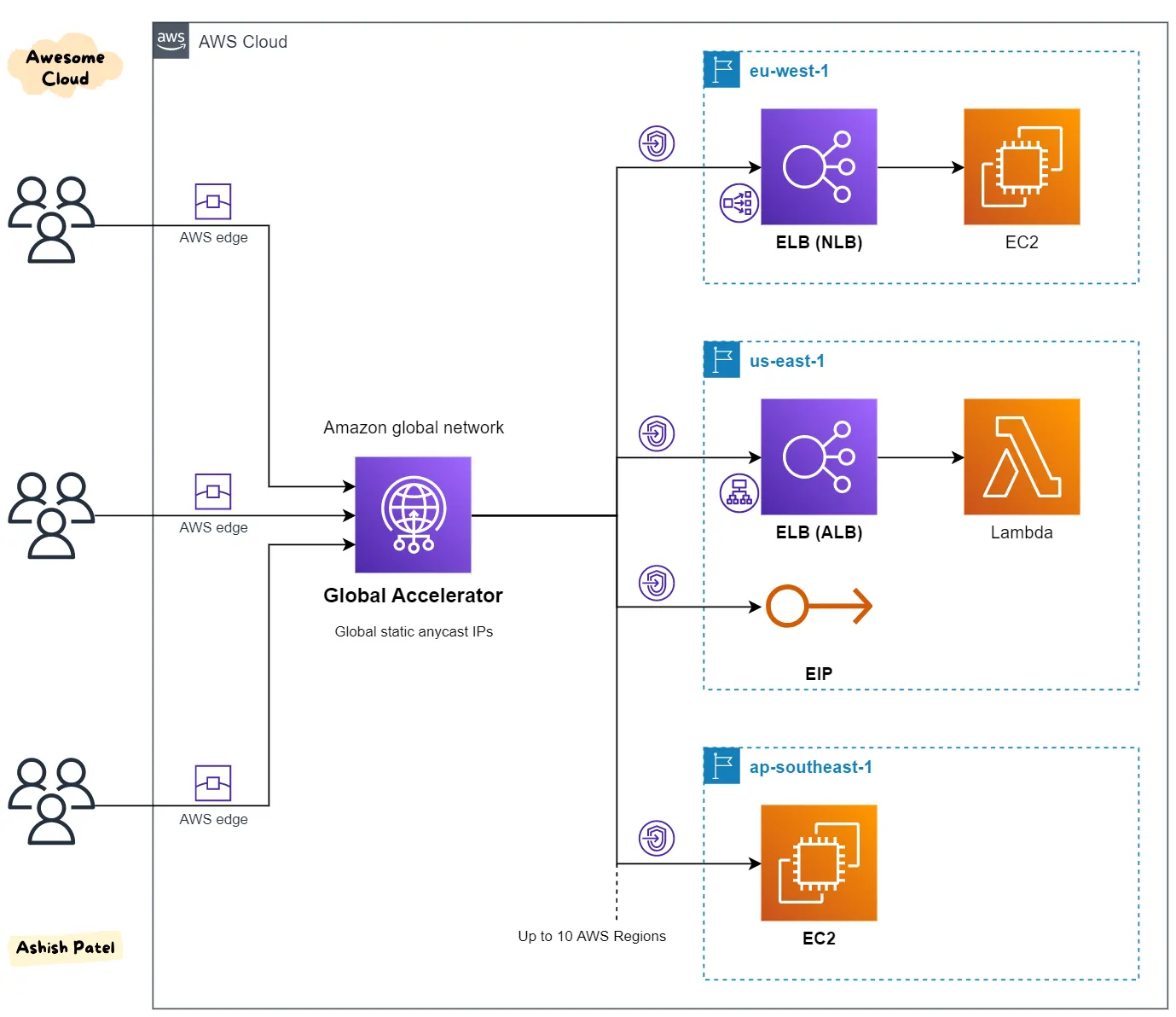
AWS Global Accelerator is a networking service designed to enhance the availability, performance, and resilience of applications for global users. It leverages AWS edge locations and the AWS global private backbone network to optimize traffic routing. The service dynamically routes user requests to the nearest edge location and then directs the traffic to the closest healthy regional endpoint where your application is hosted.
Additionally, AWS Global Accelerator uses static Anycast IPs, which act as fixed entry points for applications across multiple AWS regions. These Anycast IPs ensure that traffic is routed to the nearest available endpoint, providing low-latency connectivity and fault tolerance.
AWS Global Accelerator supports both TCP and UDP traffic, making it suitable for a wide range of applications that require low latency, high availability, and resilient routing.
1. How AWS Global Accelerator Works?
Global Accelerator provides two static Anycast IPv4 addresses for efficient routing. It optimizes routes by reducing hops to enter Amazon’s network, minimizes latency, and ensures traffic is routed only to healthy endpoints for improved performance and availability.
Global Accelerator supports the following endpoints:
- Elastic Compute Cloud (EC2) Instance
- Elastic IP Address
- Application Load Balancer (ALB)
- Network Load Balancer (NLB)
2. AWS Global Accelerator: Endpoint Groups
An Endpoint Group is a collection of endpoints located in a specific AWS region. In AWS Global Accelerator, you can create multiple endpoint groups to route traffic across one or more regions.
- Endpoints within an endpoint group can include Application Load Balancers (ALBs), Network Load Balancers (NLBs), Elastic IPs, or EC2 instances located in that region.
- Global Accelerator continuously monitors the health of all endpoints in an endpoint group and dynamically routes traffic to the nearest healthy endpoint based on the user’s location, endpoint health, and routing policies.
- If an endpoint becomes unhealthy, Global Accelerator automatically redirects traffic to a healthy endpoint in another region, ensuring seamless availability and performance.
3. Common Use Cases
- Non-HTTP Applications: Suitable for gaming (UDP), IoT (MQTT), and VoIP applications requiring low-latency, high-speed routing.
- HTTP Applications: Supports applications requiring static IP addresses, fast failover, or deterministic regional routing.
4. CloudFront vs Global Accelerator
| Feature | CloudFront | Global Accelerator |
|---|---|---|
| IP Address | Uses multiple sets of dynamically changing IP addresses | Provides a set of static IP addresses as a fixed entry point |
| Pricing | Mainly based on data transfer out and HTTP requests | Charges a fixed hourly fee and a Data Transfer-Premium (DT-Premium) fee |
| Edge Location Usage | Caches content at Edge Locations | Uses Edge Locations to find the optimal pathway to the nearest regional endpoint |
| Protocol Support | Designed to handle HTTP protocol | Supports both HTTP and non-HTTP protocols such as TCP and UDP |
5. Route 53, Global Accelerator, CloudFront, ALB, and EC2
Solution Architect approach for a global e-commerce website with millions of users across the world needs:
- When a user visits
www.globalecom.com, Route 53 resolves the domain to AWS Global Accelerator's static IP addresses. - Global Accelerator determines the nearest AWS Region and then routes the user's request to the most optimal Region using the AWS backbone.
- If the user requests static content, CloudFront caches and serves the content from an Edge location close to the user.
- If the user requests dynamic content then request flows through Global Accelerator to the regional ALB. ALB forwards the request to EC2 instances in the target Region.
- For regional failures, Global Accelerator automatically reroutes traffic to another healthy Region.
Workflow: Route 53 → AWS Global Accelerator → [CloudFront (Static Content) + ALB (Dynamic Content)] → EC2 Backend
6. Route 53 Geoproximity vs AWS Global Accelerator
| Feature | Route 53 Geoproximity | AWS Global Accelerator |
|---|---|---|
| Automatic Failover | Yes, but requires manual policy configuration. | Fully automatic with no manual setup needed. |
| Health Checks | Must be explicitly configured for each endpoint. | Built-in and automatically applied to endpoints. |
| Latency Optimization | No, traffic may flow through the public internet. | Yes, uses AWS global network for low latency. |
| Routing Flexibility | Geoproximity routing can prioritize regions based on proximity or custom bias. | Dynamically optimizes based on user proximity and endpoint health. |
7. Global Private Backbone Network
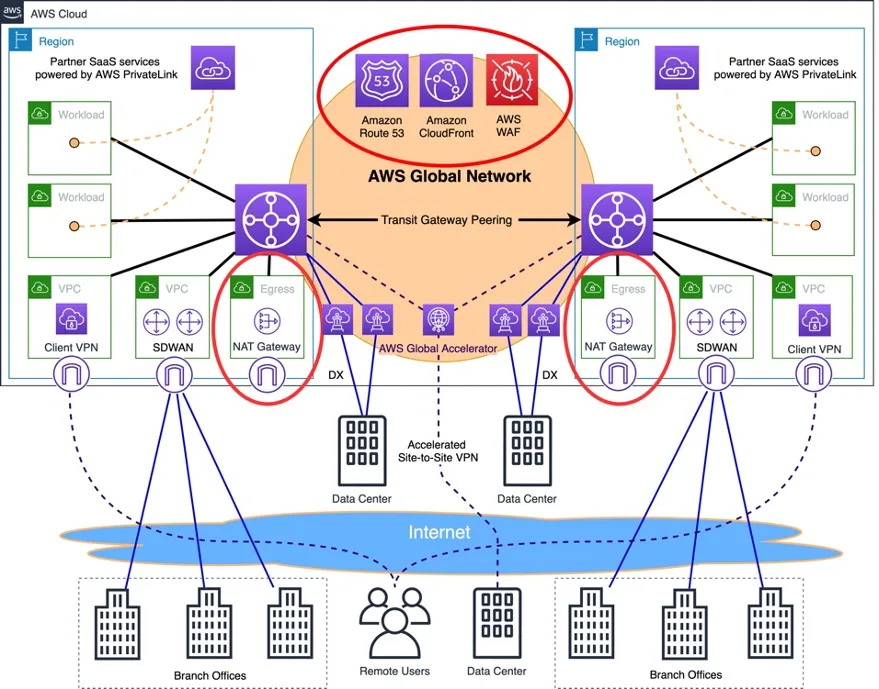
AWS owns, operates, and maintains its global private backbone network, which connects all 26 AWS regions, 84 Availability Zones, and edge locations worldwide. This network is designed to provide fast, secure, and reliable communication between AWS services, ensuring low latency and high availability.
This private backbone forms the foundation for key AWS services such as AWS Global Accelerator, AWS Direct Connect, and other applications that rely on secure global connectivity and low-latency performance.